Project Apollo: One Giant Leap
The story of the program that landed humans on the Moon — from tragedy to triumph, from Earth to the Sea of Tranquility.
- Part 1 — Project Mercury: America's First Astronauts
- Part 2 — Project Gemini: Learning to Fly
- Part 3 — Project Apollo: One Giant Leap
- Part 4 — Artemis: Return to the Moon
On July 20, 1969, Neil Armstrong stepped off the ladder of a spacecraft roughly the size of a small garage and placed his boot on the surface of the Moon.
Eight years earlier, America had barely managed to put a man in space for 15 minutes.
The story of how it happened is not a straight line. It runs through tragedy, brilliance, political will, and the work of 400,000 people whose names history has largely forgotten.
The Fire
Before the triumph, there was disaster.
On January 27, 1967, astronauts Gus Grissom, Ed White, and Roger Chaffee were running a routine ground test inside the Apollo 1 command module when a fire broke out. The cabin had been pressurized with pure oxygen — a technical decision inherited from Mercury that seemed reasonable in a vacuum, and lethal in hindsight. A spark, likely from faulty wiring, was all it took.
The hatch opened inward. Under the pressure differential, the crew couldn’t open it. All three were dead within seconds.
The program stopped. For 20 months, nothing flew. NASA took everything apart, found every flaw, and rebuilt. The hatch was redesigned to open outward. The oxygen atmosphere was replaced with a nitrogen-oxygen mix. Hundreds of wiring problems were corrected.
The lesson was brutal and necessary: complacency was as dangerous as any rocket.
Going Around the Moon
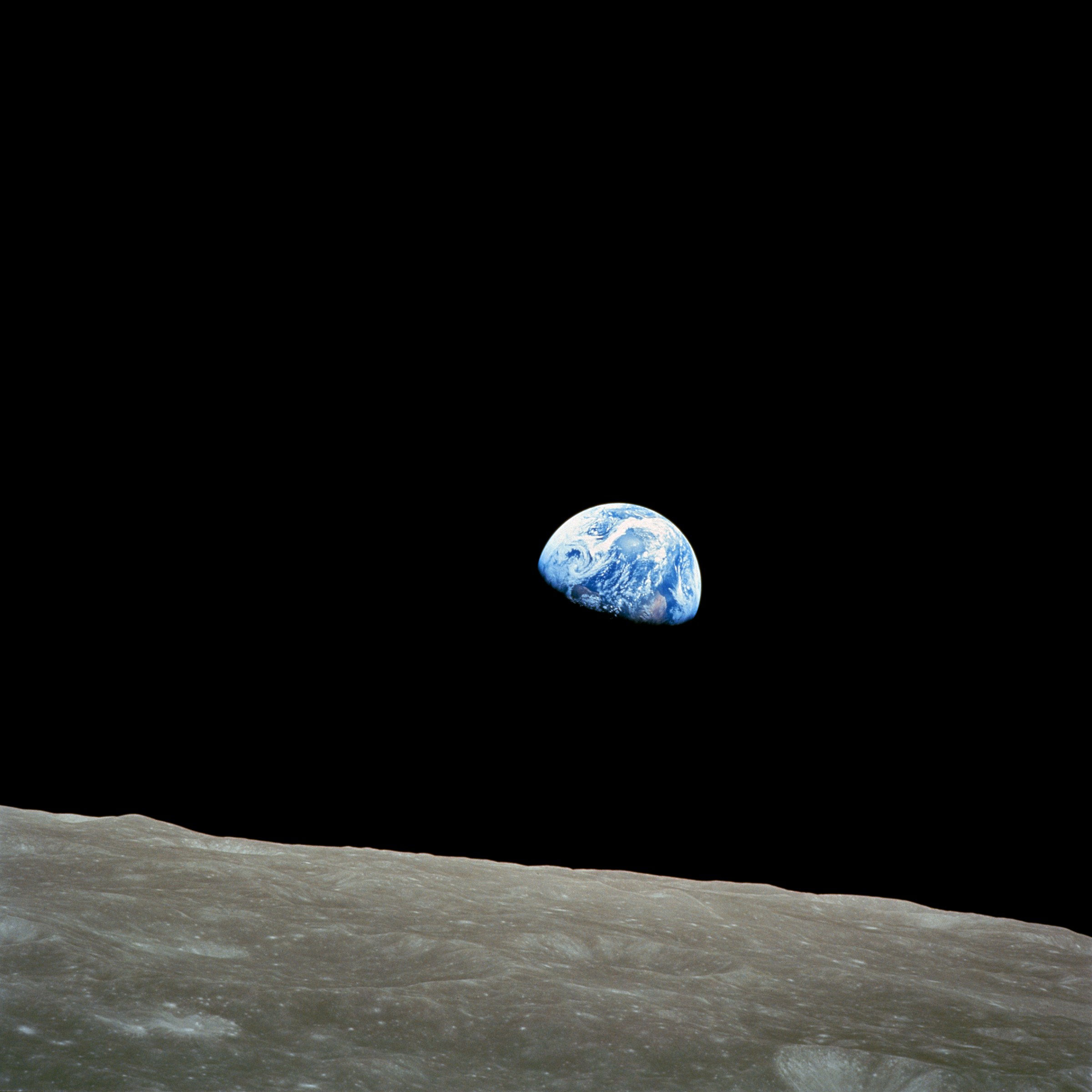
By late 1968, Apollo was flying again — and under new pressure. Intelligence reports suggested the Soviet Union was preparing to fly cosmonauts around the Moon. If they got there first, the entire program could be politically moot.
NASA made a bold call. Apollo 8 — originally planned as an Earth-orbit test — would go to the Moon. No lander, no landing: just Frank Borman, Jim Lovell, and Bill Anders flying a command module to lunar orbit and back.
On December 24, 1968, as their spacecraft rounded the Moon for the fourth time, Bill Anders looked out his window and saw something no human had ever witnessed from that distance: Earth, whole and fragile, rising above the grey lunar horizon. He grabbed a camera.
The image he took — Earthrise — became one of the most reproduced photographs in history. It didn’t just document a mission. It changed how humanity thought about itself.
Apollo 11: The Mission

Neil Armstrong, Buzz Aldrin, and Michael Collins launched from Kennedy Space Center on July 16, 1969. Four days later, Armstrong and Aldrin separated from Collins in the lunar module Eagle and began their descent to the Sea of Tranquility.
The final approach nearly went wrong. The guidance computer started throwing error alarms — codes the crew had never seen in training. Flight controller Steve Bales made a real-time judgment call: the computer was overloaded but still functional. He told Mission Control to keep going. Mission Control told the crew.
With the alarms still sounding and 30 seconds of fuel remaining, Armstrong looked out the window and saw the designated landing zone covered in boulders. He took manual control, flew over the field, and set down.
“The Eagle has landed.”

Armstrong stepped onto the surface at 10:56 PM EDT on July 20. An estimated 600 million people — the largest television audience in history to that point — watched live.
“That’s one small step for [a] man, one giant leap for mankind.”
Aldrin joined him 19 minutes later. They planted a flag, deployed scientific instruments, collected 47.5 pounds of samples, and spoke briefly with President Nixon. After 21 hours and 36 minutes on the surface, they lifted off to rejoin Collins in orbit.
Apollo 13: Failure Is Not an Option
Apollo 13 launched on April 11, 1970. Two days later, 200,000 miles from Earth, an oxygen tank in the service module exploded.
In minutes, the crew lost most of their electrical power, oxygen, and water. The Moon was no longer the destination. Getting home was.
What followed over the next four days was the most extraordinary problem-solving episode in spaceflight history. Engineers on the ground devised workarounds for systems that had never been designed to work that way. The crew used the lunar module as a lifeboat, powered down the command module to conserve power, and navigated a precise course home using manual calculations.
They splashed down on April 17. All three crew members survived.
Flight director Gene Kranz, who led the rescue effort, had told his team at the outset: “Failure is not an option.” It became the motto of an era — and a testament to what human ingenuity can do under pressure.
Twelve Men, Six Landings
Apollo landed on the Moon six times between 1969 and 1972. Each mission went farther from the landing site, deployed better instruments, and brought home more data than the last. Later missions carried the Lunar Roving Vehicle — an electric buggy that let astronauts explore miles from the lander.

Twelve human beings walked on the Moon. They collected 842 pounds of rock and soil. They left behind seismometers that are still — in a sense — listening.
The last man to walk on the Moon was Eugene Cernan, on December 14, 1972. He climbed back into the lunar module, looked at his bootprints in the grey dust, and said:
“We leave as we came and, God willing, as we shall return, with peace and hope for all mankind.”
Nobody has returned since.
Why Did It End?
Apollo ended not because it failed, but because it succeeded — and the political moment that created it had passed. Kennedy’s goal was achieved. The Cold War rivalry that funded the race had shifted. The money went elsewhere.
The Saturn V, the most powerful rocket ever flown, was retired. The tooling was destroyed. The expertise scattered.
What Apollo left behind wasn’t hardware. It was proof: that when humans commit fully to a goal — with money, will, and the willingness to accept risk — almost nothing is impossible.
Next in the series: Artemis — Return to the Moon, where NASA aims to go back — and this time, to stay.